
What Is Metal Stamping?
Metal Stamping is a cornerstone metal-forming process prized for both efficiency and precision. In a stamping process, flat metal sheets are fed into a tooling system where controlled pressure shapes raw material into parts with specific shapes and structural features. Common metal forming techniques include blanking, bending, and drawing. With its rapid cycle times and stable production rhythm, stamping dramatically enhances part consistency and throughput. Today, precision stamping is indispensable across industries such as optoelectronics, automotive, consumer electronics, telecommunications, and home appliance components.
Metal Stamping Die Types : Single-Stage & Progressive Dies
Single-Stage Die (Single-Operation Die)
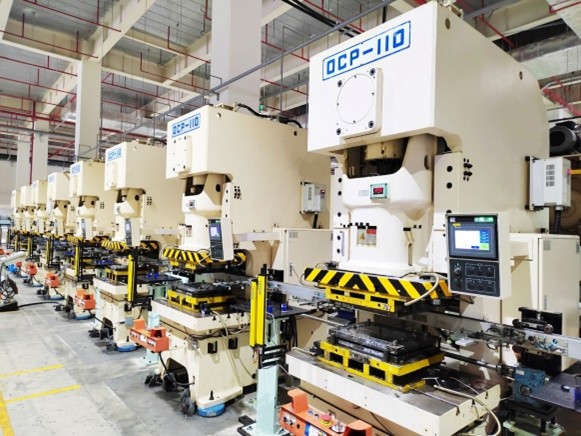
A single-stage die performs one discrete metal stamping operation per press stroke at a single station. Typical processes include:
- Bending (e.g., flange bends)
- Embossing or coin pressing
- Piercing and trim cutting
The single-stage die shines in its simplicity: low upfront cost, fast lead times, and flexible tooling changes. It’s ideal for prototypes, pilot runs, and small‐batch orders where you need quick design iterations.
Advantages
- Low tooling cost and fast lead time
- Simple structure — ideal for prototype development, pilot runs, and small - batch orders
- Flexible tooling changes to accommodate design iterations
Limitations
- Manual or semi-automatic part feeding
- Lower overall throughput compared to multi-station solutions
A compound die is a more advanced form of single-stage die tooling that executes two or more operations—such as blanking, piercing, embossing, and bending—in a single press stroke at one station. Sometimes called a combination die when it handles both cutting and forming, this approach reduces material handling and aligns multiple features at once.
Progressive Die
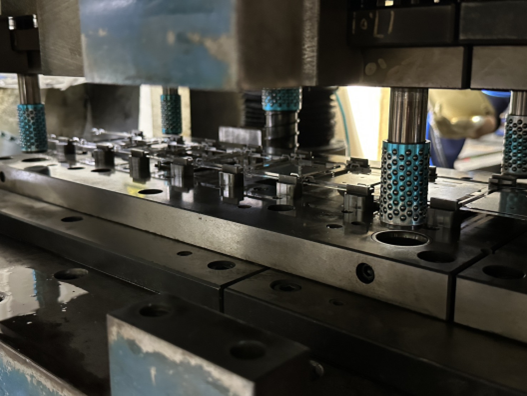
In a progressive die, a continuous metal coil feeds automatically through multiple stations embedded in a single die set. Each station carries out an operation—blanking, piercing, bending, cut-off—in sequence until the finished part is released. When you compare single-stage die versus progressive die, the progressive solution excels in high-volume metal stamping thanks to full automation.
Advantages
- Extremely high production rates with fully automated coil feeding
- Reduced part handling and minimal secondary operations
Limitations
- Higher upfront tooling investment due to complex die design
- Longer lead time for die manufacturing and setup
- Best leveraged in high-volume production environments
| Die Type | Typical Applications | Typical Applications | Monthly Output | Unit Cost(NTD/pc) | Cycle Time(s/pc) | Tooling Lead Time (weeks) | Automation Level |
| Single-Stage Die | Low upfront cost; Simple geometry; Manual or semi-auto feeding;Ideal for prototyping | Prototype parts, small-batch; orders, simple bends or cuts | Low | High | 8–12 | 3-4 | Low |
| Progressive Die | Continuous coil feeding; Fully automated sequence; Tight tolerances; consistency; Best for large runs | High-volume production, complex multi-step parts | High | Low | 1.5–3 | 4–6 | High |
Chia Chang’s Technical Advantages in Precision Stamping
- Outstanding Dimensional Consistency & product quality stability
- Ultra-high Production Throughput with seamless automation integration
- Competitive Manufacturing Costs through optimized die design
- Comprehensive Precision Die Solutions tailored to customer needs
As the heart of any stamping operation, die design and machining accuracy directly influence part aesthetics, cycle time, and overall cost of ownership. Leveraging deep expertise in both structural and functional tooling, Chia Chang delivers turnkey solutions—from prototype runs to full-scale production—that hit target yields and keep your market rollout on schedule.
How Company B Surged from 4K to 11K pcs/day in 3 Months
Background
● Industry : 3C tablet internal components manufacturer
● Material : Aluminum
● Previous Setup : Stage dies with automated transfer systems
Challenges
● Daily output capped at 4K pcs
● Yield : only 50%
Solution
● Optimize leveling equipment and improve mold design precision.
● Strengthen internal personnel training to improve production yield efficiency.
Results (First 3 Months)
|
Metric |
Before |
After |
Improvement |
|
Daily Output |
4,000 pcs |
11,000 pcs |
↑ 175% |
|
Yield |
50% |
90% |
↑ 80% |
Combined with automation system to achieve Faster Production and Unwavering Precision
Chia Chang Group currently centers its stamping operations on a hybrid approach: combining the flexibility of single-stage with the speed of progressive dies, all linked by automated transfer systems. Workpieces move seamlessly between stations, maximizing throughput while preserving the tight tolerances that precision stamping demands.
Ready to see how the right die solution can transform your production?Contact our team today for a free die-selection consultation to pinpoint the perfect tooling setup for your next project.